A crucible for metals must be able to get hotter than its contents and must not contaminate the melt. Graphite crucibles can be used regardless of the metal up to around 1,200 to 1,300°C. In graphite crucibles, the main difference between inexpensive and expensive models is durability, because the more expensive German crucibles contain more silicon carbide and aluminium oxide and no clay. Ceramic crucibles made of pure aluminium oxide withstand up to 1,700°C, but are sensitive to thermal shock, brittle, and usually have a significantly shorter service life than graphite crucibles. The second question is size, because crucibles are specified in cubic centimetres, and how much metal fits depends on its density.
Purpose and distinction of the crucible
In non-ferrous metal casting, a crucible has three interlocking tasks. It holds the solid metal while it melts. It then keeps the melt at temperature. And it transports it to where it is poured. In doing so, it must withstand temperatures above the melting temperature of the alloy being charged, without changing or contaminating the melt.
The pouring ladle is distinct from the crucible. It is a tool for pouring off, and with small quantities of low-melting metals it can also be used to melt directly. Our pouring ladles aus Stahl sind für Zinn, Bismut, Zink und Aluminium bis etwa 800 Grad Celsius ausgelegt und sollten nicht dauerhaft darüber belastet werden. Geschmolzen wird im geschlichteten Löffel bis etwa 400 bis 500 Grad Celsius, also Zinn, Bismut, Blei und Zink. Darüber, etwa bei Aluminium, dient er nur noch zum Schöpfen. Zum Schutz vor Korrosion schlichten Sie die Gießlöffel immer ein. Bei Zink schlichten Sie den Löffel besonders oft und großzügig ein, sonst legiert sich der Stahl mit dem Zink. Selbst gut geschlichtet greift die Zinkschmelze den Stahl mit der Zeit an, weil Zink und Eisen ineinander übergehen. Schlichten Sie deshalb großzügig nach oder nehmen Sie einen Löffel oder Aufsatz aus Grafit. Als Schöpfwerkzeug endet der Gießlöffel dort, wo sein Volumen nicht mehr reicht oder das Metall heißer als etwa 800 Grad Celsius wird. Dann brauchen Sie einen Tiegel.
Crucible materials from graphite to aluminium oxide
For non-ferrous metal casting, most crucibles are made from clay-bonded graphite or resin-bonded silicon carbide. With graphite, it is worth taking a closer look, because the same name is used for very different crucibles. Pure graphite begins to oxidise in air at around 450 to 500°C, but remains usable up to around 1,200°C. In use, the crucible slowly dissolves. Under protective gas or in a vacuum, the same material can withstand up to 3,000°C. For the crucibles themselves, the ceramic content is the distinguishing feature. The product information does not state a temperature limit for each type, but it does indicate the ranking of service life.
If you need graphite beyond crucibles, you will also find under graphite products auch Gussformen und Rundstangen; für eine 2026 veröffentlichte Arbeit haben Forschende aus Grafitstäben dieses Sortiments ihre eigenen Tiegel gefertigt. Der keramische Anteil ist auch im Sortiment das unterscheidende Merkmal. Die Grafittiegel für Elektroöfen bestehen aus reinem Grafit. Die Tiegel ohne Ausguss und der 600er mit Ausguss bestehen aus Grafit mit Anteilen von Siliciumcarbid und Siliciumoxid. Den höchsten keramischen Anteil haben die MIG-Grafittiegel (Made in Germany) mit Ausguss. Sie bestehen aus 36 bis 46 Prozent Grafit, 12 bis 20 Prozent Siliciumcarbid und Silicium, 12 bis 16 Prozent Aluminiumoxid und 20 bis 28 Prozent Siliciumdioxid. Durch diesen höheren keramischen Anteil sind die MIG-Grafittiegel am hitzebeständigsten und langlebigsten, gefolgt von den Tiegeln ohne Ausguss und dem 600er mit Ausguss. Die Tiegel für Elektroöfen verschleißen am schnellsten, weil sie aus reinem Grafit bestehen.
Alongside graphite, the range also includes oxide ceramics. Our Al2O3 ceramic crucibles can be used up to 1,700°C and therefore offer the greatest headroom. However, they are sensitive to abrupt temperature changes to the extent that rapid heating or cooling can damage or destroy the crucible. We therefore use ceramic crucibles for special cases, for example when the melt must not come into contact with carbon. Crucibles made from other advanced ceramics are also available. They are not part of the standard range, but we can usually source them for you.
Matching crucibles and metal correctly
Selection takes place in two steps. First, check where your metal melts. Then you need a crucible whose service temperature is above that, with a safety margin, because the melt must be hotter for pouring than for mere melting. For copper-tin casting alloys, the pouring temperature is around 50 to 100 K above the liquidus temperature. This range cannot be transferred to other alloys. The furnace also plays a role, because in some small electric furnaces only graphite crucibles of certain dimensions can be used sensibly.
| Metal | Melting point or melting range | Suitable melting vessel |
|---|---|---|
| Tin | around 232°C | Pouring ladle or graphite crucible |
| Bismuth | 271°C | Pouring ladle or graphite crucible |
| Lead | around 327°C | Pouring ladle or graphite crucible |
| Zinc | around 419°C | Pouring ladle (very well coated) or graphite crucible |
| Aluminum | around 660°C | Graphite crucible, also with ceramic content; pouring ladle for scooping only |
| Brass CuZn39Pb3 | 880 to 895°C | Graphite crucible, graphite crucible with ceramic content, or ceramic crucible |
| Brass CuZn37 | 902 to 920°C | Graphite crucible, graphite crucible with ceramic content, or ceramic crucible |
| Silver | around 962°C | Graphite crucible, graphite crucible with ceramic content, or ceramic crucible |
| Bronze CuSn12-C | 830 to 1,000°C | Graphite crucible, graphite crucible with ceramic content, or ceramic crucible |
| Gold | 1,063°C | Graphite crucible, graphite crucible with ceramic content, or ceramic crucible |
| Copper | around 1,085°C | Graphite crucible, graphite crucible with ceramic content, or ceramic crucible |
For the pure metals, a melting point is given; for the three alloys, a range. As soon as you alloy, the picture shifts, which is why brass and bronze are listed in the table with a specific alloy designation rather than as a generic category. Copper-tin alloys have a wide solidification interval and therefore tend to segregation. Even a small addition of phosphorus has a deoxidising effect in these bronzes and improves castability. There is no fixed melting point for bronze or brass, because both are umbrella terms for many alloys.
From zinc onwards, i.e. from the fourth row, the difference between graphite grades becomes apparent. Over many melts, crucibles made of pure graphite slowly wear away and become thinner-walled; in principle, however, they remain perfectly usable.
At the lower end of the table, the crucible question is straightforward. For pure tin ingots, for bismuth granules and for lead, a steel pouring ladle or any graphite grade is sufficient, because all of them have ample headroom here. How such casting works in practice is explained in our guide to casting tin figurines. We advise against using a ceramic crucible for tin figurines; a pouring ladle or graphite crucible is sufficient here.
Ab zinc pellets und Aluminium hält eine Sorte mit keramischem Anteil länger, weil reiner Grafit hier schneller zehrt. Gut geschlichtete Gießlöffel sind hier noch verwendbar, eher aber als Werkzeug, um das Metall vom Tiegel in die Form zu bringen. Bei Brass, Bronze und Copper arbeiten Sie dann im unteren Drittel der Tabelle. Die Produktangabe nennt alle Tiegelsorten des Sortiments für diese Metalle, der Unterschied liegt in der Standzeit: Je höher der keramische Anteil eines Grafittiegels, desto länger hält er. Bei Messing kommt ein Punkt hinzu, der nichts mit dem Tiegel zu tun hat. Das enthaltene Zink siedet bei 906 Grad Celsius und dampft deshalb aus der heißen Schmelze aus. Dieser Zinkabbrand lässt sich durch Abdecken mit trockener Holzkohle oder einem neutralen Schmelzmittel teilweise unterbinden. Schmelzen Sie Messing häufig auf, muss Zink nachlegiert werden. Achten Sie beim Schmelzen von Messing immer auf gute Belüftung.
Determining the right crucible size
Crucibles are specified by volume, and that explains a specification that is confusing at first glance. In our size tables, the columns are labelled “max. Cu” and “max. Al”. They refer to the maximum load in kilograms, calculated using copper at 8.92 g/cm³ and aluminium at 2.7 g/cm³. The same crucible therefore holds very different masses depending on which metal you charge.
Therefore, calculate from your casting. You need the volume of the part plus sprue and riser, plus a little remainder in the crucible, and the crucible must be able to hold this volume. A graphite crucible with a spout with a capacity of 600 cm³ holds 5.3 kg of copper or 1.6 kg of aluminium. The smallest crucibles in the range hold 50 cm³, which is suitable for individual figurines; the largest hold 4,500 cm³.
A crucible that is too large is not a safety gain; it costs energy and heat-up time for metal you do not need. One that is too small tempts you to overfill. If you cannot find anything suitable in the range in terms of volume or design, ask us about special shapes and special dimensions; we can source them on request.
Furnace type and crucible design
In addition to material and size, the heating method also matters. For small electric furnaces there are dedicated graphite crucibles for electric furnaces. They are made of pure graphite, which brings the material question from above back into play: if you melt brass, bronze or copper in an electric furnace, a grade with ceramic content will last longer. In gas furnaces, the electric-furnace crucibles can in principle also be used, but for gas furnaces there are crucibles with a better design. Ask about this before you order. Also measure the interior of your furnace and compare it with the height and top diameter of the crucible.
The second design question is the spout. With a spout, you can pour from the crucible in a controlled manner; without a spout, you skim or decant. Our graphite crucibles without a spout are simple in design and, thanks to their price-performance ratio, are particularly suitable for beginners and occasional casters. For regular casting and high demands on service life, the more durable graphite crucible is worthwhile, i.e. the MIG graphite crucibles with a spout.
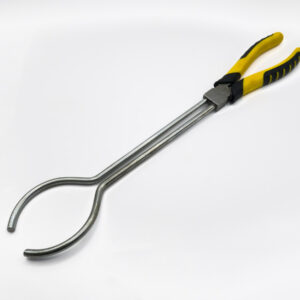
Plan the gripping method from the outset. Our electric-furnace crucibles have a recess at the top so they can be gripped with suitable tongs. Suitable crucible tongs are not an accessory you think of later, but part of selecting the crucible. The tongs for electric-furnace crucibles are 35.5 cm long, weigh 270 g and fit common electric-furnace graphite crucibles, such as our 100, 200 and 250 cm³ sizes.
Service life and typical crucible damage
Three types of stress determine how long a crucible lasts: high operating temperatures, mechanical stress during charging, and frequent temperature changes. Two of these are under your control; the third is determined by your metal.
Pure graphite oxidises in air, and among the graphite crucibles in the range, one lasts longer the higher its ceramic content. Ceramic crucibles are sensitive to thermal shock. Therefore, never heat at full power from the start, change the temperature gradually, and avoid contact with cold surfaces. Let a red-hot ceramic crucible cool down slowly in the furnace; otherwise it will crack. The shop does not specify a heating rate for the ceramic crucibles. If your crucible comes with a manufacturer’s recommendation, that is the authoritative guidance.
Mechanically, two mistakes are particularly costly. Hard impacts from ingots during charging can lead to cracks and breakage, so fill the crucible carefully. And crucibles expand when hot, which is why they must never be wedged in the furnace. A crucible that fits exactly when cold is under stress when hot. Store it dry and protected from moisture.
Working safely with molten metal
Moisture is the hazard that is most easily underestimated when melting. If water hits a melt, it evaporates instantly, the steam greatly increases the pressure, and the melt splashes. This steam pressure can occur with any hot melt, regardless of the metal.
Therefore, keep crucibles, tools, charge material and the work surface dry as long as the metal is liquid, and do not cool either mould or metal with water. For foundry operations, the DGUV requires keeping refractory materials, casting auxiliaries and all areas dry where metal or slag in liquid form could reach. The same rule points out that insufficiently preheated refractory material may contain moisture. Applied to the crucible in the workshop: store dry and bring up to temperature slowly. Also heat a pouring ladle before immersing it so that any water evaporates.
When it comes to protective equipment, the industrial standard is a sensible benchmark, even if you are melting in your own workshop. For steelworks and foundries, occupational safety specifies safety goggles and non-flammable, heat-insulating gloves, as well as clothing without easily melting synthetic fibres. The DGUV additionally requires flame-retardant or non-flammable protective clothing for foundry operations and heat-resistant helmets in areas with molten masses. At your own workbench, safety goggles, heat-insulating gloves and clothing without easily melting synthetic fibres are the minimum before you switch on the furnace.
Finding the right crucible for your metal
Selection therefore rests on four pillars. The metal determines the temperature, which determines the material. The casting quantity determines the volume, converted via density. The furnace determines the design, and handling determines spout and tongs. For your first melting attempt with tin or bismuth, the most affordable graphite grade or a pouring ladle and suitable tongs will take you a long way.
All sizes and materials are available side by side in the range. Once the crucible is decided, the next step is the mould the metal will later flow into, and for that we offer graphite casting moulds. Small quantities can be ordered directly via the shop; larger quantities are available on request. If you are unsure which crucible fits your metal and your furnace, it is better to clarify this with us before your first pour than afterwards.
Frequently asked questions about crucibles
Can I melt different metals one after another in the same crucible?
A crucible should neither change nor contaminate the melt, and that is exactly where the limit lies when switching. If composition matters or lead has been involved, use a separate crucible for each metal and label it. For identical or related alloys, one crucible is sufficient.
How can I tell that a crucible should be replaced?
Check it for cracks before every use, because they can be caused by thermal shock, hard impacts during charging, and after prolonged, repeated use or long dwell times in the furnace. With crucibles made of pure graphite, material loss due to oxidation in air is an additional factor. A crucible with a crack no longer belongs in the furnace.
May a crucible be clamped tightly in the furnace?
No. Crucibles expand when hot and must therefore never be wedged in place. A crucible that fits exactly in its holder when cold is under stress when hot. Leave it clearance and install it so that it can expand freely.
Related products in the shop
-

Graphite Crucible without Spout
Price range: 27,49 € through 109,99 € inkl. MwSt. -
Graphite Crucible Made in Germany
Price range: 35,49 € through 89,99 € inkl. MwSt. -
Al2O3 Ceramic Crucible
Price range: 17,99 € through 87,99 € inkl. MwSt. -
Crucible Tongs for E-Furnace Crucibles
Price range: 62,49 € through 119,99 € inkl. MwSt.