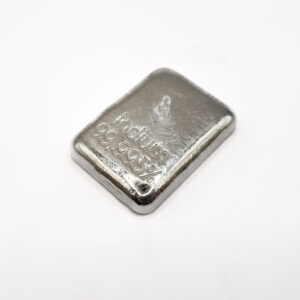
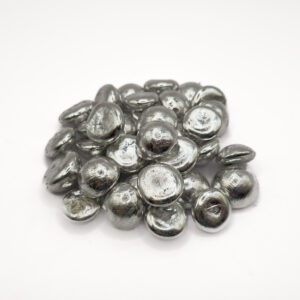
The most important use of indium is in screens. Worldwide, most of it is processed into indium tin oxide, a conductive and transparent layer for displays and touchscreens. The silvery metal itself is so soft that it can be cut with a knife. It melts at 156.6°C. In the workshop and laboratory, it serves as solder, as a seal, and as an alloying element for alloys that become liquid below 100°C.
Properties of Indium
Indium is the element with the symbol In and atomic number 49. With a Mohs hardness of 1.2, it is very soft and also highly malleable. When pure indium is bent, it produces an audible creaking sound, because the crystals in the metal rub against each other. The same sound in tin is known as tin cry.
The melting point is 156.6°C and the density is 7.31 g/cm³. Because the melting point of indium can be determined very precisely, it serves as one of the fixed points on which the temperature scale is based.
Liquid indium wets glass, leaving a thin film on it. Below 3.41 Kelvin, just above absolute zero, it becomes superconducting and conducts electricity without resistance. You can find pure indium for your own experiments as ingots, granules, wire, or round rod under Buy Indium.
Use of Indium in Electronics
Since the 1990s, indium tin oxide, abbreviated ITO, has been the most important application of indium. This compound conducts electricity, wets glass, and is transparent. For this reason, it serves as a conductive layer in LCD and OLED screens, in touchscreens, and in solar cells.
As a compound, indium is also found in semiconductors. Indium nitride, indium phosphide, indium arsenide, and indium antimonide are used in light-emitting diodes, photodiodes, and laser diodes. Copper indium diselenide absorbs an especially large amount of light and is therefore used in thin-film solar cells.
Further Uses of Indium in the Lab and in Technology
In low-temperature technology, indium seals cryostats, i.e. containers in which samples are cooled to very low temperatures. It is well suited for this because it is gas-tight and remains malleable even at low temperatures. It also serves as a solder that can be used to join glass and ceramics.
In nuclear reactors, indium captures both slow and fast neutrons effectively, making it suitable for alloys used in control rods. Hafnium is also a possible alternative there.
Occurrence and Extraction
Indium occurs almost exclusively as a byproduct of zinc or lead production, most commonly during the processing of sphalerite, a zinc sulfide ore. It was discovered by Ferdinand Reich and Hieronymus Richter in 1863 at the Freiberg Mining Academy.
Low-Melting Indium Alloys
Alloyed with tin, bismuth, or gallium, indium usually lowers the melting point. Certain mixing ratios produce eutectics, i.e. mixtures that melt and solidify completely at a fixed temperature. The table below shows six indium alloys from our range, sorted by melting point.
| Alloy | Composition | Melting Point |
|---|---|---|
| InSn48 | 52% indium, 48% tin | 118°C |
| BiIn33 | 67% bismuth, 33% indium | 109°C |
| InBi33.7 | 66.3% indium, 33.7% bismuth | 72°C |
| Field’s Metal | 51% indium, 32.5% bismuth, 16.5% tin | 62°C |
| Ga-In Eutectic | 76% gallium, 24% indium | approx. 15.7°C |
| Galinstan | 68.5% gallium, 21.5% indium, 10% tin | approx. 11°C |
The four alloys that only melt above room temperature can be found under Indium Alloys. Which one is right for you depends mainly on the temperature at which it needs to become liquid. The highest melting point belongs to the InSn48 eutectic at 118°C. It is noticeably softer and tougher than the bismuth-containing alloys. It is used, among other things, as solder and for filigree parts and cores.
The InBi33.7 indium-bismuth eutectic already becomes liquid at 72°C, while Field’s Metal does so at just 62°C. Field’s Metal is suitable as a casting alloy and as a solder for glass, and is an alternative to the lead- and cadmium-containing Wood’s Metal. The similarly named BiIn33, on the other hand, contains more bismuth than indium (67 to 33 percent) and does not melt until 109°C. If the higher temperature is not an issue, it is more affordable than InBi33.7 and Field’s Metal. You can find further low-melting mixtures, including ones without indium, under Bismuth Alloys.
The two gallium-containing alloys, the Ga-In eutectic and Galinstan, are liquid at room temperature and are therefore supplied in syringes or bottles. Because they attack aluminum, they should not come into contact with it. The safety data sheet is available on request.
Available Forms of Indium
For melting down, ingots are available in 1 kilogram (132 x 36 x 30 millimeters) and 100-gram ingots (50 x 30 x 8 millimeters). For small quantities and precise weighing, the granules are more practical, as they can be measured out starting from 1 gram. Individual granules weigh approximately 0.1 to 0.2 grams. The wire is available in 10-gram portions, either with a diameter of 1 millimeter and a length of 2 meters, or with a diameter of 2 millimeters and a length of 1 meter. The round rod measures 8 millimeters in diameter and 100 millimeters in length.
Ingots, granules, and wire have a purity of at least 99.995 percent, or 4N5 for short. The round rod reaches 99.999 percent (5N), making it especially interesting for laboratory applications. A certificate of purity for indium is available on request. Companies, laboratories, and institutes can order on invoice after verifying their customer account, giving them up to 30 days to pay. From an order value of 100 euros, you can redeem a voucher code in your cart for a volume discount, starting at 2 percent and reaching 10 percent from an order value of 600 euros.
Frequently Asked Questions About Indium
Is indium toxic?
The known hazard classifications apply to indium as dust and powder, as well as to the compounds indium phosphide and indium tin oxide. They do not make any statement about ingots, granules, or wire as solid metal. Indium powder also irritates skin and eyes and is flammable. In Germany, a workplace exposure limit of 0.0001 milligrams per cubic meter applies to respirable indium dust. The MAK Commission recommends classifying indium dust as carcinogenic, category 2. The International Agency for Research on Cancer (IARC) classifies indium phosphide as probably carcinogenic and indium tin oxide as possibly carcinogenic.
Can indium be recycled?
Yes, the recycling of production scrap, i.e. leftover material from processing, is particularly widespread. Indium is most commonly recovered from ITO scrap, especially in Japan and South Korea. However, recycling played only a minor role in supplying the EU in 2020.
Is indium a critical raw material for the EU?
Not anymore. Indium was still on the EU’s list of critical raw materials from 2020. Regulation (EU) 2024/1252 revised this list in 2024. Since then, indium no longer appears on it, neither among the critical nor among the strategic raw materials.