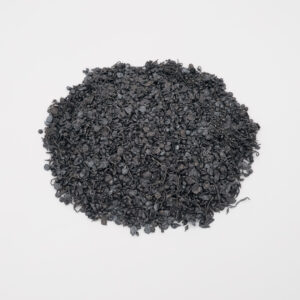
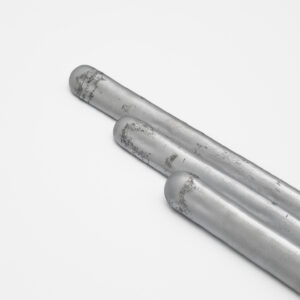
The melting point of lead is 327.46°C, which is a good 95°C/Kelvin above that of tin. More important than the exact temperature when melting is how the metal enters the body. When working with lead, exposure comes only partly from the air you breathe; a significant portion enters the mouth via the hands. Clean hands and a melt that is no hotter than necessary reduce uptake. Dry tools prevent water vapour from making the melt splatter.
Melting point of pure lead
Pure lead becomes liquid at 327.46°C, which corresponds to around 600.6 Kelvin.
Like any pure metal, lead has a fixed melting point rather than a melting range; the transition from solid to liquid happens abruptly. It then remains liquid over a wide temperature range, because depending on the source lead does not boil until 1,740 to 1,749°C. For casting, weight also matters. According to the product specification, pure lead has a density of 11.34 g per cubic centimetre, so one litre of solid lead weighs a good 11 kg.
Lead compared to other metals
Among common casting metals, lead sits between bismuth and zinc. The table shows rounded values for pure metals.
| Metal | Melting point in °C |
|---|---|
| Tin | approx. 232 |
| Bismuth | 271 |
| Lead | approx. 327 |
| Zinc | approx. 419 |
| Aluminium | approx. 660 |
| Copper | approx. 1,085 |
Melting point of lead alloys
When other metals are added, the fixed point usually becomes a melting range in which solid and liquid phases coexist. Our hard lead Pb84Sb16 consists of 84% lead and 16% antimony. It melts between 252 and 285°C, i.e. below pure lead, and is intended for strong solder joints and hard lead cast parts.
Tin-rich tin-lead alloys are even lower. Our SnPb37 with 63% tin and 37% lead is specified as a eutectic tin-lead alloy and melts like a pure metal at a fixed point, at 183°C. “Eutectic” refers to a composition in which the start and end of melting coincide. For casting, the alloy is available as SnPb37 granules. SnPb40 with 60% tin, by contrast, melts in a narrow range from 183 to 190°C. Depending on composition, SnPb37 and SnPb40 are also used as electronic solder; other tin-lead alloys are used as roofer’s solder or body solder. The lead alloys category shows further alloys containing lead.
Equipment for melting lead
A furnace that just barely melts tin is not sufficient for lead. In addition, casting is not done exactly at the melting point, because some melts become viscous as they cool, which promotes defects. A fixed casting temperature for pure lead cannot be stated across the board. As a rule of thumb, the pouring temperature should be about 50°C/Kelvin above the melting temperature. The furnace, crucible, and mould must withstand the pouring temperature. Therefore, check the maximum ratings of your equipment before your first pour.
Our HB silicone rubber is intended for moulds for casting with tin, lead, and bismuth alloys. Its load limit is 400°C, and briefly 450°C when pouring. This still leaves enough headroom above the melting point of lead. Even so, for a silicone mould you should only heat lead as much as needed so that it pours well.
Lead fumes and lead dust when melting
Under European chemicals legislation, lead is classified as reprotoxic category 1A. It can impair fertility, harm the unborn child, and harm infants via breast milk. When lead is heated strongly, it also produces vapours and smoke with very fine, respirable particles. Therefore, do not keep the melt any hotter than the casting requires.
Lead is hardly absorbed through the skin. Some enters the body via inhaled dust and smoke, and a significant portion via hand-to-mouth contact. How much lead ends up in the blood therefore depends heavily on personal hygiene.
For pregnant employees, the Maternity Protection Act (Mutterschutzgesetz) regulates work with lead. The employer must not allow a pregnant woman to carry out activities where there is a risk that she will absorb lead. The law does not apply in a private workshop, but the underlying rationale does. Pregnant women should therefore not work with molten lead there either, and because lead can harm infants via breast milk, the same applies to breastfeeding women.
Melting lead safely
If liquid metal comes into contact with water or moisture, the water evaporates, the vapour increases the pressure sharply, and the melt splatters. Crucibles, tools, and any lead you add must therefore be completely dry. Bring a pouring ladle up to temperature before dipping it into the melt so that any water evaporates. While the metal is liquid, do not cool either the mould or the metal with water.
Extract vapours and smoke as close to the melt as possible. General room ventilation is the weaker solution and does not replace local extraction. If employees in your company melt lead, TRGS 505 applies to you as an employer—the Technical Rule for Hazardous Substances for lead—which explicitly covers the melting and casting of lead.
Do not eat, drink, or smoke at the melting station, and do not place food or drinks there either. After work and before every break, wash your hands, arms, and face and rinse your mouth. Safety goggles, non-flammable heat-insulating gloves, and clothing without easily melting synthetic fibres are specified by occupational safety rules for steelworks and foundries; in your own workshop, they are a good guideline.
Sourcing pure lead and lead solders
We stock pure lead Pb99.9 in three forms. Lead ingots Pb99.9 are available from 1 to 20 kg, plus coarse lead granules and lead pellets of around 200 g each, which are easy to dose. We sell these three items only to commercial or institutional customers with a verified account. This applies to businesses as well as institutions, including universities and associations, each with their own registration in the shop. The product information for hard lead Pb84Sb16, SnPb40, SnPb37 granules, and the tin-lead eutectic SnPb37 specifies the same ordering process.
Verification is done by email with proof of business. Activation takes a few working days. After that, you order directly in the shop and, if desired, pay on invoice with up to 30 days’ payment term.
For private casting projects such as figures, lead-free metal is a good option. Especially for figures that are played with or handled frequently, we recommend low-lead or lead-free alloys. SnPb37 and SnPb40 are still good figure alloys that are easy to process. According to the product specification, pure tin pellets Sn99.9 are lead-free, melt at 231.93°C, and are often used for casting figures. Our guide to casting tin figures shows how to make a mould and cast them.
Frequently asked questions about lead
How hot is liquid lead?
Liquid lead is at least at its melting temperature of 327.46°C. Below that, it solidifies. It remains liquid up to the boiling point of around 1,740°C; how hot the melt actually gets depends on the heat source. However, strong heating produces vapours and smoke with fine, respirable particles. Therefore, do not turn the furnace or burner up to full power, but only as far as the casting requires.
Is pure lead toxic?
Yes. Lead is classified as reprotoxic category 1A; it can impair fertility, harm the unborn child, and harm infants via breast milk. For lead powder, the classification additionally states organ damage from prolonged or repeated exposure. Lead is hardly absorbed through the skin. It becomes dangerous when lead gets from the hands into the mouth or when dust and smoke are inhaled.
Is leaded solder still permitted?
That depends on the application. The ElektroStoffV, the German implementation of the RoHS Directive, does not regulate the solder but the devices. Electrical and electronic equipment may only be placed on the market if each homogeneous material contains no more than 0.1% lead by weight. The annexes to the Directive provide exemptions for specific uses. As lead-free alternatives to SnPb37, the product information lists SnCu0.7 and SnAg4 from the eutectic tin solders.