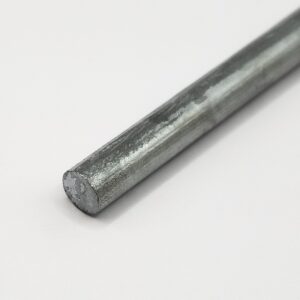
Germanium shines gray like a metal but is hard and brittle, classified today as a semiconductor. This metalloid, with atomic number 32, melts at 938.25 degrees Celsius and is found in fiber optics and infrared optics, as well as in semiconductor components and solar cells. In our shop, you can purchase the high-purity elemental metal as round rods. It has little to do with organic germanium, which is marketed as a capsule.
Place in the Periodic Table and Discovery
It already had its place in the periodic table directly below silicon before anyone held it in their hand.
Dmitri Mendeleev had left a gap at this position, naming the missing element Eka-silicon. He predicted an atomic mass of approximately 72 and a specific gravity of 5.5 for it. Clemens Winkler identified the element in 1886 in Freiberg, Saxony, in the mineral argyrodite, determining its values as 72.32 u and 5.47 g/cm³.
Properties of Germanium
Germanium melts at 938.25 degrees Celsius and only boils at 2,833 degrees Celsius; its density is 5.323 grams per cubic centimeter. Tin melts at around 232 degrees Celsius, and zinc at around 419 degrees Celsius. Germanium falls between aluminum, at around 660 degrees Celsius, and copper, at around 1,085 degrees Celsius.
Its behavior at the transition between solid and liquid is unusual. Like water, solid germanium is less dense than its melt, meaning it expands upon solidification.
Chemically, germanium is quite unreactive. It remains stable in air at room temperature and is not attacked by hydrochloric acid. However, concentrated nitric acid and hot concentrated sulfuric acid dissolve it. In its crystal structure, germanium atoms arrange themselves like those in diamond. Mechanically, its brittleness is noticeable, as germanium breaks under impact or bending instead of deforming.
Uses of Germanium
In the USA, fiber optics is the largest application area, followed by infrared optics, semiconductors and solar cells, and radiation detectors. Depending on the application, the metal or a compound is used.
| Application | Form Used | Purpose |
|---|---|---|
| Fiber optics for data and telecommunications | Germanium dioxide and germanium tetrachloride | Layer in the quartz glass of the fiber |
| Infrared optics in thermal imaging cameras and night vision devices | Germanium metal as a lens or window | Allows heat radiation to pass through |
| Solar cells in space travel | Germanium wafers | Substrate for multi-junction solar cells |
| Radiation detectors | High-purity germanium single crystals | Detection of radiation |
| PET plastic | Germanium dioxide | Catalyst in production |
For some of these applications, alternative materials exist. In certain electronic applications, silicon or gallium arsenide can take its place; in infrared optics, chalcogenide glass can be used; and antimony and titanium also serve as catalysts for plastics.
Occurrence and Supply Situation
Germanium occurs in certain zinc ores and in lead-zinc-copper ores, as well as in lignite deposits. It is extracted as a byproduct, for example, during the processing of zinc concentrates. Some of it comes from recycling, as chips from the processing of infrared optics, waste from fiber optic manufacturing, and germanium wafers from solar cell production are reprocessed.
Elemental Metal and Organic Germanium
Those looking for effects of germanium quickly come across capsules containing organic germanium, such as Germanium-132. They share only the element with the elemental metal.
In 2000, the then-responsible Federal Institute explicitly warned against Germanium-132 capsules as dietary supplements. Even small amounts could damage the lungs, liver, nerves, and kidneys, and in at least five cases, prolonged, regular intake led to death. According to the institute, deficiency symptoms due to insufficient germanium are not known.
Legally, germanium is also not permitted as a mineral to be added to dietary supplements. Directive 2002/46/EC and the German Food Supplement Ordinance only allow listed minerals and their approved compounds for this purpose, and germanium is not on this list. The germanium round rods in our shop are a material for technology and research, not a dietary supplement.
Delivery Forms and Purity
In our Germanium category, you will find the element with a purity of 99.999 percent, or 5N in technical terms. The Germanium Round Rods 5N are available with diameters of 3 or 8 millimeters and lengths of 50 or 100 millimeters. An 8-millimeter diameter rod weighs between 13.3 and 26.6 grams, depending on its length.
We can procure other lengths, diameters, or germanium as granules upon request. For institutions and businesses, a verified customer account is available with purchase on account and payment terms of up to 30 days. If you need other elements for experiments in addition to germanium, you will also find Silicon 6N Round Rods, Gallium as a Round Rod, and an Indium Round Rod in rod form. The entire selection of rod material can be found under Round Rods, and all elements under Overview of Pure Metals.
You can order germanium directly from the online shop for gross merchandise values up to 6,000 Euros; shipping within Germany is free. Larger quantities are delivered upon request.
Frequently Asked Questions about Germanium
What is the German name for Germanium?
Germanium is already the German name for the element. Its discoverer, Clemens Winkler, named it after the Latin word Germania for Germany. The chemical symbol is Ge.
Is germanium radioactive?
Natural germanium consists of five isotopes, and one of them, Germanium-76, decays via the extremely rare double beta decay. The measured half-life is around two sextillion years, or 2 times 10 to the power of 21 years, and Germanium-76 makes up only 7.75 percent of natural germanium.